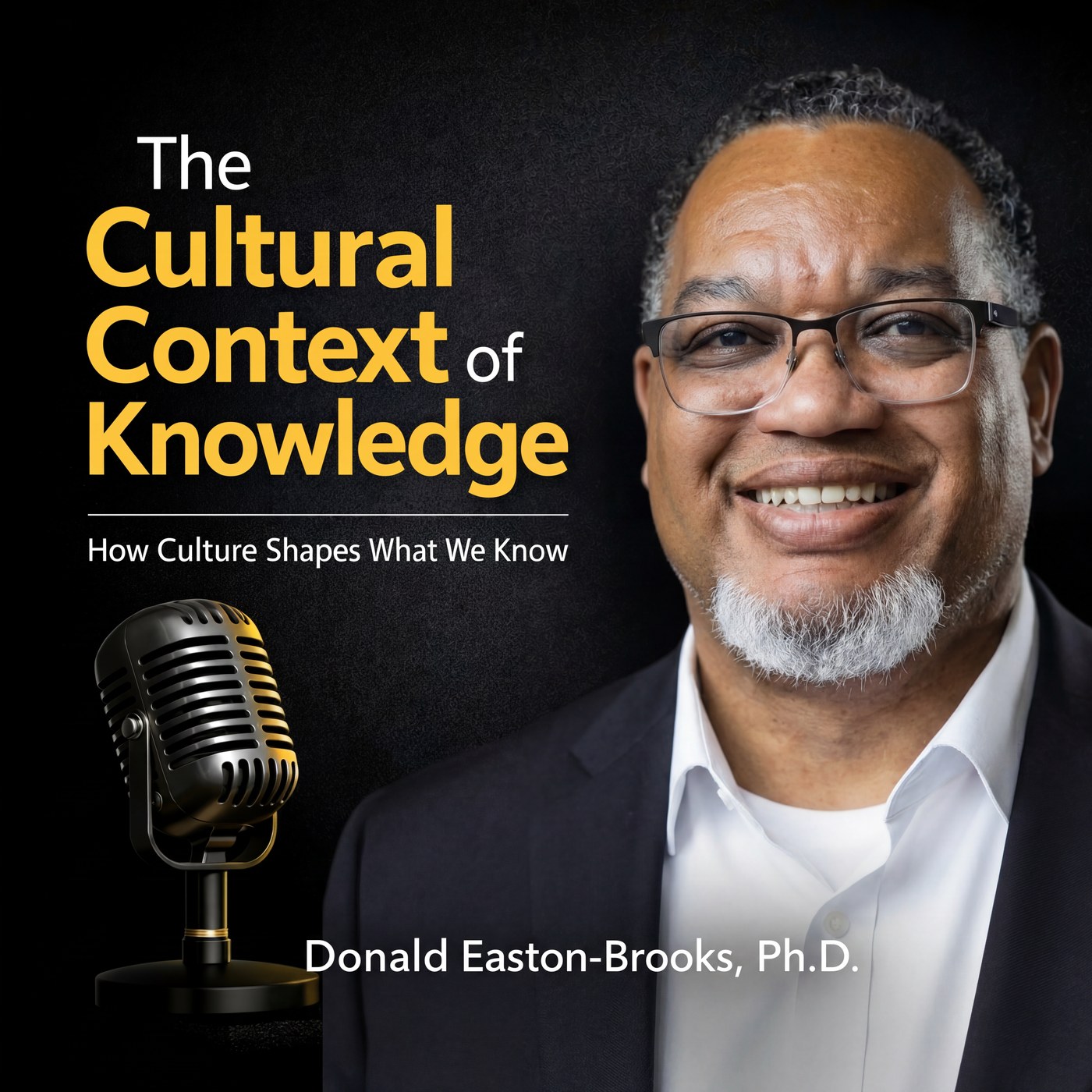
This is one of two featured episodes in Season 1, the episodes that set the show’s center of gravity and that the rest of the season keeps returning to. Episode 2 takes the same source material that Episode 1 ran through NotebookLM and delivers it in Don’s voice. The content is the same. The argument is the same. What changes is the texture, and the texture is the point.
The episode does three things at once. It states a working theory of learning. It states a working theory of AI’s role in learning. And it states a working theory of how culture shapes what counts as good knowledge. None of those three are new ideas, but the episode insists on holding them together. You cannot understand the AI argument without the learning argument underneath it, and you cannot understand either without the cultural-context argument that runs through both.
The core claim, stated plainly
Learning is a struggle. The sentence is not romantic. It is not a defense of frustration or suffering. It is a description of what is actually happening when learning is real. The learner moves from what is unclear, unfamiliar, or unstable, toward clearer understanding. The struggle can be simple, a task that is doable but new to you, or complex, when the task requires prior concepts, language, or experience you have not yet built.
The difference is not intelligence. The difference is what you have to work with as a learner.
This single move, separating struggle from incapacity, does a lot of work. It tells the educator that struggle is often misread. We sometimes treat struggle as evidence that the learner is not ready, when it is often evidence that the learner is actively constructing readiness. Learning is not the receipt of information. It is the reorganization of understanding. The practical question is not how do we remove struggle. The practical question is how do we scaffold struggle so the learner stays engaged long enough for understanding to form.
The kindergartner writing the letter A
The episode runs a careful example. A child is asked to draw the letter A. First, a diagonal line from the top center, pulling the pencil slightly to the left. The child has held a pencil before, has drawn random circles and lines, but has not been asked to draw with precision and intention. The first line may be possible but not automatic. So the child draws it once, then repeats. Repetition is not busy work. It is the process by which a movement becomes controllable.
Then a mirrored line in the opposite direction. Then the connection at the top midpoint. Then the horizontal line across the middle. Then on to B, with curves and proportion. The point is not that this is dramatic struggle. The point is that even simple learning involves struggle, and the level of simplicity varies among learners. One child picks up writing quickly. Another needs more time. The sequence is the same. The readiness within the sequence differs.
Now scale up. Riding a bike. Reading. Algebra. Each of these requires foundational skills before the learner can meaningfully attempt the task. In those contexts, skipping foundations does not just slow learning down. It can prevent learning from happening.
Bloom’s three stages, the load-bearing version
The episode uses Bloom’s taxonomy in a specific way, not as six grading levels, but as three load-bearing stages. The basic level. The compare-and-contrast level. The abstract level. Those three are the spine.
The basic level is where definitions, purposes, and functions are built. Foundations are not optional. They are load-bearing. Without them, the rest of the structure cannot stand. The episode is plain about this. For writing to make sense to a child, the child must understand what a letter is, why letters matter, and what the goal of the task is. The child needs language and purpose. This is also where motivation enters, and motivation, the episode insists, is not a separate soft factor. It is often the fuel that keeps a learner engaged through the struggle.
The compare-and-contrast level is where the learner clarifies meaning by differentiating. The child compares the diagonal lines to make the letter A symmetrical. The child compares A and B, not only their appearance, but their sound. Both are letters, but they function differently. Comparison is not just an academic strategy. It is a cognitive mechanism for sharpening understanding.
The abstract level is where learning becomes generative. Letters become words. Words become sentences. Sentences become style and voice. At this level, the learner is not reproducing knowledge. They are using knowledge to construct something new.
The episode anticipates the standard critique, that learning is not linear. The response is careful. Linear and sequential are not the same. Learning does not have to be a single straight line. Learners can loop back, move at different speeds, approach a concept from multiple angles. But learning is still scaffolded. The sequence matters because foundations shape what is possible at higher levels. For educators, Bloom’s becomes a diagnostic tool. When learners stall at analysis or creation, the problem may not be effort. The problem may be that the basic level was never fully built.
Where AI fits, and where it doesn’t
Now the episode turns to the question that organizes the entire season. Where do AI tools, ChatGPT, Gemini, NotebookLM, the rest, fit in this learning process?
The answer is not avoid AI. The answer is more useful and harder to do. Design AI use that honors the learning sequence.
AI can be valuable. It can accelerate access to explanations. It can generate examples. It can provide feedback loops. It can help learners rehearse, compare, and clarify. It can reduce the time it takes to find resources. It can support writing, planning, and revision. None of those uses are problems.
The risk is that people start AI at the third level, the abstract, without building the first and second. They ask for high-level products. Polished answers. Finished essays. Lesson plans. Complex solutions. They ask for those products before they have a conceptual understanding of the problem. Yes, in some cases people can learn backward. But without conceptual understanding, the backward approach often lengthens the learning process rather than shortening it. Without criteria, the learner refines prompts through trial and error, uncertain about what to ask, what to trust, and what to revise.
The episode is careful about what AI is doing. ChatGPT and Gemini are predictive models. They learn patterns from very large data sets and generate responses that are statistically likely given the prompt. That can be powerful. It also means the quality of the output depends heavily on the user’s ability to guide the tool. If the learner does not understand the task, they cannot guide the tool effectively, and they cannot reliably detect errors. The failure mode is predictable. Irrelevant or overly general output. Inaccurate claims that sound confident. A learning process that appears efficient on the surface but is unstable beneath it.
The instructional move that follows is not avoidance. It is sequence-respecting prompting. The episode offers examples worth keeping in front of you. Define these key terms in plain language, then give one example and one non-example. Ask me five questions to check whether I understand the basics before we move on. Show me two common misconceptions and how to test for them. Generate a short practice set that starts simple and increases in complexity. Give me a checklist of what I should know before attempting this task. In this approach, AI serves as scaffold. It supports the struggle. It does not erase it.
Why cultural context is not an add-on
The most important section of Episode 2 is the one most listeners hear last, the cultural-context argument. Hard sciences are grounded in discipline-based laws that behave like absolutes under consistent conditions. Drop an object without restrictions and it will fall. Reliability allows for stable predictions. Social life and social science are different. People will react. People will not react with the same precision across time, context, tone, identity, power, and experience. Human responses are lawful in the sense that they occur. They are not absolute in the sense that they repeat identically.
Here is the crucial sentence. What people know and how they interpret it is deeply shaped by cultural and historical experience. All human experience has context. There is always a history.
That sentence is the spine of the show. Knowledge is not just information. Knowledge is information interpreted through lived experience, shaped by cultural narratives, and influenced by power, especially whose interpretation is treated as standard or true. Master narratives or grand narratives can dominate a system’s shared sense of reality. Mini narratives, the lived truths of non-dominant communities, get ignored or suppressed. When that happens, the system’s knowledge base becomes biased, even if the people inside it have not noticed. Categories like order versus disorder and civilized versus non-civilized get treated as neutral. The result is systematic error and, in many cases, dehumanization.
Now layer this on top of the AI argument. AI systems are trained on human language at scale. That language includes dominant narratives, institutional assumptions, and the patterns of acceptable knowledge as represented in the data. If educators and learners treat AI output as neutral, they risk importing master narratives into the classroom and calling it objectivity. In culturally complex domains, educational policy, discipline, curriculum, identity, community history, AI can produce responses that sound coherent while reproducing bias. And if the learner has skipped foundational understanding, they are less equipped to notice what is missing, whose voice is absent, or which assumptions are being smuggled in.
This is why the cultural context of knowledge is not an add-on to AI literacy. It is central to it.
Three commitments
The episode names three commitments for a culturally responsible approach to AI-enhanced learning.
Contextualize knowledge. Teach learners to ask: what is the historical and cultural setting of this claim? What experiences shape how different communities interpret this issue?
Pluralize knowledge. Teach learners to look for many narratives, community perspectives, lived accounts, historically marginalized interpretations, especially when the topic affects real lives and real opportunity structures.
Validate through negotiation and evidence. Shared knowledge is built through interaction, testing, confirming, challenging, and revising understanding with others. Discussion, critique, sources, lived experience, and empirical checking all matter.
Why this is a featured episode
Two reasons. First, this is the episode that states the show’s working theory most completely. Every later episode either depends on it or pushes against it. The cultural-context argument here is the lens through which Season 1’s STEM episode (Episode 4), the seven-phase learner series (Episodes 5–11), and the entire arc of Season 2 become readable.
Second, this is the episode that does the show’s most important translation. The same argument that the AI voices delivered in Episode 1 lands differently in Don’s voice. You can hear what AI compresses out of a careful argument when nobody is watching. You can also hear what a single human voice carries that a fluent summary cannot. That contrast, Episode 1 and Episode 2, side by side, is itself a cultural-context lesson. Knowledge is not just information. It is information interpreted through lived experience. The argument and the medium are the same case.
A few questions worth sitting with
What does foundation mean inside a course you are teaching or taking right now? Is it being built, or being assumed?
When was the last time you used an AI tool at the abstract level without building the basic level first? What did the output cost you in time, accuracy, or trust?
Whose narratives are present in the curriculum you work with? Whose are missing? When you ask an AI tool for help, which set is it more likely to amplify?
Where in your own teaching or learning have you mistaken efficiency for development?
Two things to try this week
One small move at the foundation. Pick a single topic, a course unit, a project at work, a topic for a presentation, and spend twenty minutes at the basic level only. Definitions, functions, purposes. Plain language. No AI. Then, and only then, bring an AI tool into the work and see how the output changes when you have the foundation in hand.
One small cultural-context check. For the next thing you read, write, or assign, ask three quick questions. What is the historical and cultural setting of this claim? Which lived experiences would interpret this differently? What evidence, including the experience of people closest to the topic, would I want to see before I trust this fully? Three short answers. Five minutes. The discipline is not in the depth of the answers. It is in the habit of asking.
A closing note
The episode ends with the cleanest single sentence in the season. AI should compress time, not compress development. That line is worth pinning above your desk. Most of the season will keep walking out from it.
DEB