The Cultural Context of Knowledge · Companion essays
The argument, in print.
Every episode travels with a written companion — the same argument on the page, with the sources, counter-arguments, and what the audio had to leave on the cutting-room floor.
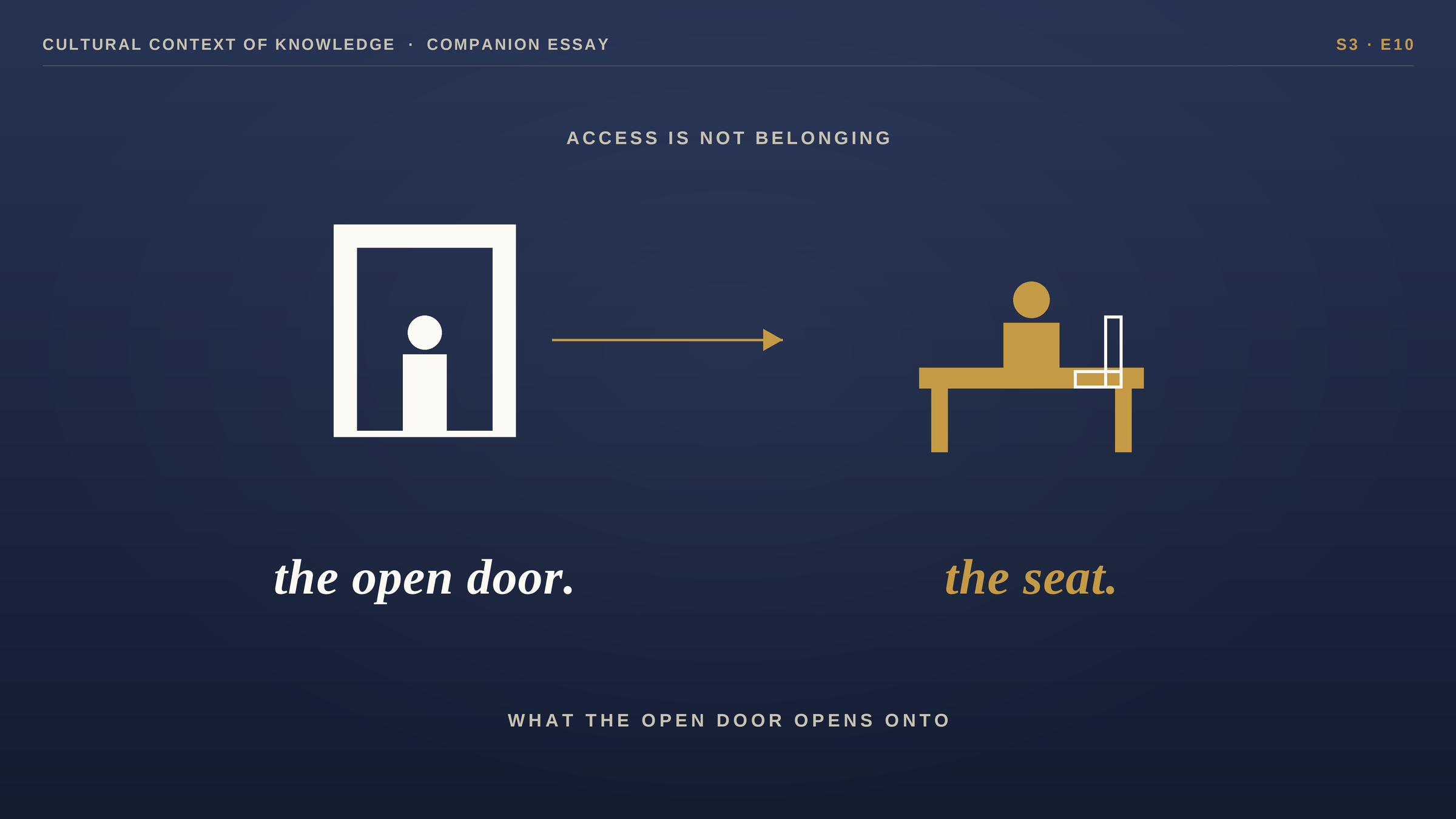
For nine episodes, ethnic matching stayed inside the PK through 12 classroom. This companion walks it through the college door. The demographic wave charted in 2009 has landed: for the first time in the history of the United States, more than half the population under twenty-one is People of Color. Access was the old fight, and it was largely won. Belonging is the new one. Three pillars of matching in higher education, the tenure tax Faculty of Color pay once they are hired, and the line between a recruiting photograph and real reform. Access is not belonging.
Read the companionCompanion to S3 E9July 30, 2026
From Research to Policy
The case for ethnic matching was built across thirty years. This companion asks the question deferred just as long: what does it take to turn that research into policy that lasts? The workforce gap that will not close, the three structural barriers that keep it open, the four routes that have actually worked, and the line between aspiration and infrastructure that Brown v. Board and the DEI rollback both fall on. Intention is temporary. Infrastructure lasts.
10 min readRead
Companion to S3 E8July 23, 2026
Where Is the Data
A doctoral student sits in the back of a Denver board meeting and watches lived, documented knowledge get waved off in about nine seconds. A board member asks where the numbers are, and the proof of whole communities does not count as an answer. Between 2000 and 2025 a generation of researchers put a number on what the storytellers had already proven, and paid for the asking. A companion essay on the turn from story to statistic, and the cost of the translation.
10 min readRead
Companion to S3 E7July 16, 2026
The Research Comes Home
In 1966 the Coleman Report measured six hundred thousand children and missed the ones it claimed to see. A generation of scholars of color read it, decided the numbers had never truly seen their communities, and put the survey down. Between 1980 and 2000, across Black, Mexican American, Indigenous, and Asian American communities at once, they picked up oral history, ethnography, and memory, and won back the right to say what was worth measuring. A companion essay on the turn that had to come before the numbers.
11 min readRead
Companion to S3 E6July 9, 2026
The Chair Was Full
I was born in 1964 and went to school in Texas, and across thirteen years I can count maybe two or three white teachers. Everyone else at the front of my classroom was Black, and most of them lived on my street. I had the match. In those same years the country sent its experts out to measure children like me. They measured the buildings, counted the budgets, and priced the books. They missed me entirely. A companion essay on the last tax of the season: waiting for an outsider's permission to be believed about your own life.
10 min readRead
Companion to S3 E5July 2, 2026
What Winning Cost
In the spring of 1951, a sixteen-year-old led four hundred and fifty classmates onto a picket line, and the walkout became one of the five cases decided as Brown v. Board of Education. A child started it. Brown was right, and separate was never equal. But in carrying the ruling out, school boards kept the desks and fired the teachers, more than thirty-eight thousand Black educators within a decade. A companion essay on the cost hidden inside the victory.
11 min readRead
Companion to S3 E4June 25, 2026
The Lie in the Lesson
Between 1921 and 1940, the lesson itself became the weapon. A history book that erased the child, a room that called her language a defect, a federal curriculum built to scrub a nation out of her. Carter G. Woodson named the harm. And in the same years, a teacher, a scholar, an advocate, a lawyer who each shared the children's world stood in the path of the lie. A companion essay on the answer the families called being seen.
11 min readRead
Companion to S3 E3June 18, 2026
The Schools Built Against Them
Between 1890 and 1920, the country stopped forbidding the schoolhouse and learned instead to build one, and to decide, child by child, who it would teach and who it would only manage. Black, Native, Mexican, Chinese, and Japanese families read that decision before any court or study named it, and built their own schools beside the public system. A companion essay on what the families knew first, and the teacher they sent back in.
11 min readRead
Companion to S3 E2June 18, 2026
The Teacher They Built
Four communities, four languages, one decision. In the decades before the Civil War, Black, Mexican, Chinese, and Cherokee families each built a school staffed by a teacher who already knew the children. None of them had the term ethnic matching. All of them were practicing it. A companion essay on a tradition the research would not name for another hundred years.
11 min readRead
Companion to S2 E8June 11, 2026
How State Standards Get Written: Curriculum as Compromise
State standards are the most concentrated place in U.S. public education where decisions about other people's children get made by people who never have to live with the result. The companion to Episode 8 names curriculum as compromise, asks who sits at the table when standards get written, and sketches what an accountable process would have to hold.
10 min readRead
Companion to S3 E1June 3, 2026
Before the Term
Season 3 opens before the research. Long before any economist isolated a same-race-teacher effect in a state dataset, Black educators in the segregated South had built the conditions that effect would eventually measure. A companion essay on ethnic matching as a practice that existed, was theorized, and was dismantled, before it had a name.
11 min readRead
Companion to S2 E7May 18, 2026
AI as the New Gatekeeper: Whose Voice the Models Already Heard
Generative AI is being absorbed into U.S. classrooms before anyone has named what kind of authority it carries. The companion to Episode 7 names it, traces where the training data came from, and asks what gets called knowledge once a system learns to summarize a world it never visited.
11 min readRead
Companion to S2 E6April 29, 2026
The Hidden Curriculum: When Researchers Chose the Word Violence
What changed when researchers started calling everyday classroom practices a form of violence? A companion essay on the hidden curriculum, adultification, and the developmental cost of misrecognition over twelve years of schooling — and on the word the field has been quietly asking us to use.
8 min readRead
Companion to S2 E5April 24, 2026
The Backlash: Why Newly Legitimate Knowledge Gets Targeted
Dismissal, absorption, restriction. When marginalized knowledge wins a place in the record, dominant systems respond in a predictable three-move cycle. A companion essay on why the current wave of curriculum restrictions is not unprecedented, what the research actually shows, and what the strongest counter-argument gets right and wrong.
10 min readRead
Companion to S2 E4April 18, 2026
The Other Half of Brown
Integration happened to the students. It did not happen to the teaching profession. A companion essay on the history of Black teacher displacement after Brown v. Board, and the ethnic-matching research it set in motion.
6 min readRead
Companion to S2 E3April 4, 2026
When the Lens Turns
San Francisco State in 1968, the California Gold Rush, and ethnic studies as a method rather than a position — the written version of the argument the episode had fourteen minutes to hold.
9 min readRead
Companion to S2 E2March 9, 2026
How Knowledge Becomes Legitimate
Once you ask who decides what counts as knowledge, you have to ask how knowledge becomes legitimate in the first place. Episode 2 traces gatekeeping mechanisms — peer review, citation, accreditation, and now algorithms — and what changes when the past becomes the training data for the future.
6 min readRead
Companion to S1 E2March 7, 2026
Learning Is a Struggle, in Plain Language
One of two featured episodes in Season 1 — the episodes that set the show’s center of gravity. Episode 2 takes the same source material Episode 1 ran through NotebookLM and delivers it in Don’s voice: a working theory of learning, of AI’s role inside it, and of how culture shapes what counts as good knowledge.
14 min readRead
Companion to S2 E1February 21, 2026
The Demographic Pivot
Season 2 opens with a fact almost no one writes on a whiteboard: the U.S. school system is operating with a 20th-century structure inside a 21st-century classroom. The episode argues the demographic pivot is also a knowledge-framework pivot, and equity does not mean lowering the bar — it means ensuring the bar is not invisibly calibrated for one historical group.
5 min readRead
Companion to S1 E11January 20, 2026
Phase Six: Build the Map
The series finale. Concept-mapping a sociology unit so the learner doesn't just know the content, they own it. Mastery isn't a perfect score — it's the ability to create something new with what you have learned.
5 min readRead
Companion to S1 E5January 19, 2026
Why Learning Feels Hard, and How to Stop Blaming Yourself
The opening of the seven-episode learner series. Learning as the brain rearranging its mental space, memorization vs. understanding, and Bloom's six phases as a usable mental process.
4 min readRead
Companion to S1 E6January 19, 2026
Phase One: Remember Without the Safety Net
Retrieval practice over rereading. Why recognition is not memory, and how to build flashcards that include an example so the definition has a hook.
4 min readRead
Companion to S1 E7January 19, 2026
Phase Two: Explain It So a Fifth Grader Could Get It
Three tools for understanding — the younger-student test, the because sentence, and the this is like analogy — applied to caste and class systems.
5 min readRead
Companion to S1 E8January 19, 2026
Phase Three: Take the Concept Off the Page
Phase three is where studying starts to feel useful. Application is the move from vocabulary to lens — spotting social mobility in housing and work, and meritocracy in sports culture and workplace talk.
4 min readRead
Companion to S1 E9January 19, 2026
Phase Four: Open the Hood
Stop driving the car, become the mechanic. Analysis is three specific moves: compare two similar concepts, identify the components of a system, and ask what changes if you change one variable.
4 min readRead
Companion to S1 E10January 19, 2026
Phase Five: Test the Claim
Evaluation as critical thinking, not negativity. A five-step template — claim, assumptions, evidence, trade-offs, conclusion — applied to the most consequential claim of the season: "we live in a meritocracy."
5 min readRead
Companion to S1 E4January 16, 2026
STEM Is Not Neutral
A featured episode. A guided professional learning moment for STEM educators. Why timed tasks, single solution paths, and silence-as-focus are cultural choices, not universal standards — and how to redesign STEM so rigor isn't confused with restriction.
11 min readRead
Companion to S1 E3January 16, 2026
What Counts as Knowledge?
The foundational episode of the show. Why "neutral" curriculum is not neutral, what funds of knowledge means in practice, and what the misrecognition tax costs learners whose lives don't fit the school's cultural script.
4 min readRead
Companion to S1 E1January 7, 2026
Learning Is a Struggle AI Must Not Skip (the AI Companion Edition)
The NotebookLM-generated companion to the foundational Season 1 essay — two AI voices interpreting the source material on learning, struggle, and the cultural shape of knowledge. The gap between what they hear and what they soften is the point.
4 min readRead