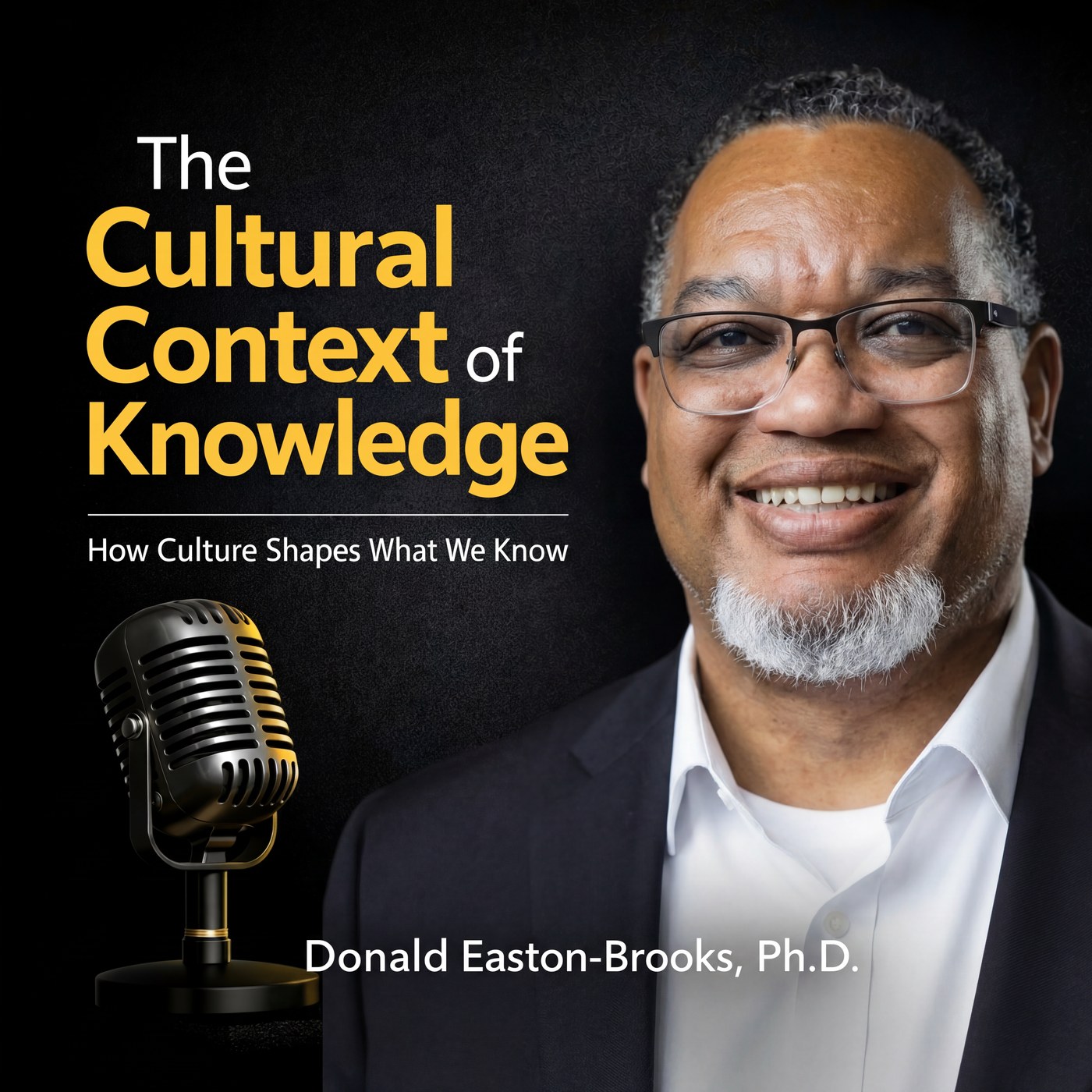
If Episode 1 named the demographic pivot, Episode 2 follows the next question. Once you ask who decides what counts as knowledge, you have to ask how knowledge becomes legitimate in the first place. Ideas exist everywhere, in classrooms, in clinics, in trades, in communities, in everyday conversations. Only some of those ideas move from everyday understanding into something institutions treat as truth. Episode 2 walks through how that move happens, who has historically had the standing to authorize it, and what changes when algorithms enter the system.
Many ways of knowing the world
The episode opens with a useful inventory. Community knowledge grows from shared experience. Practitioner knowledge develops through hands-on work, a teacher reading classroom dynamics, a nurse recognizing patterns in recovery, a farmer reading soil after years on the same land, a public-health worker learning what strategies actually reach families. Research knowledge is produced through formal studies, statistical analysis, and peer-reviewed publication.
All of these reveal truths about the world. Institutions rarely treat them the same. Universities, journals, accreditation agencies, and professional organizations tend to elevate certain forms of knowledge while overlooking others. Research knowledge often sits at the top. Community knowledge gets labeled anecdotal. Practitioner knowledge gets labeled informal. The hierarchy is not random. It reflects how institutions are structured and what they were built to recognize.
The gatekeeping mechanisms
Episode 2 traces the path academic knowledge actually travels. A researcher conducts a study. The findings are written into a manuscript. The manuscript is submitted to a journal. Peer reviewers evaluate it. If it passes, it is published. Citations build influence. Eventually the ideas appear in textbooks, policy reports, and university courses. What started as an idea has become legitimate knowledge.
Other systems run parallel paths. Curriculum committees decide what students should study. Accreditation agencies define what quality looks like in educational programs. Professional associations establish standards for entire disciplines. These systems exist for good reasons, they help maintain rigor, encourage careful evaluation of evidence, and prevent misinformation from spreading easily. They are also not purely neutral filters. They are social systems built by people operating inside institutions with their own histories, priorities, and power structures.
The episode names a few thinkers who help make this visible. Robert Merton on the norms of scientific communities, knowledge has to be recognized by the community before it becomes legitimate. Thomas Kuhn on paradigms and paradigm shifts, what counts as legitimate knowledge can change dramatically when the underlying assumptions of a field change. Michel Foucault on the inseparability of knowledge and power, institutions don’t just store knowledge, they organize it, defining the categories that determine what is normal, credible, or authoritative. Pierre Bourdieu on cultural capital, recognition depends partly on knowing the language, expectations, and norms institutions reward. Expertise is not only about discovery. It is also about recognition, and recognition happens inside institutions.
Ethnic studies as a case in point
The episode lands one historical example with weight. For much of the 20th century, universities presented knowledge through a relatively narrow lens. History courses centered European history. Literature courses emphasized Western authors. Social sciences treated Western institutions as the primary model for understanding society. As a result, many ethnic cultures and histories were largely absent from the knowledge systems universities used to interpret the world.
The lived experiences, intellectual traditions, and cultural histories of Black, Indigenous, Asian, and Latino communities existed long before universities recognized them. What changed in the late 1960s was not the existence of the knowledge. What changed was institutional recognition. Students began asking why entire communities were missing from the curriculum if universities were supposed to study society. Those questions helped give rise to ethnic studies programs, and those programs expanded the kinds of questions scholars asked about migration, identity, culture, and inequality.
This is the point worth holding. Knowledge often exists in communities long before institutions recognize it. Legitimacy is not the same as truth. Legitimacy is institutional standing. The two can move together, but they don’t have to.
Algorithms as the new gatekeepers
The episode closes with a contemporary turn. Today, legitimacy is no longer shaped only by universities and journals. It is increasingly shaped by algorithms. A student searches for a topic. A search engine ranks the results. An AI system summarizes the information. Recommendation systems decide which sources surface as authoritative.
These systems feel objective because they rely on mathematics. But algorithms learn from data, and data reflects history. If certain voices historically dominated publishing, they appear more often in the training data. If certain journals received more citations, the systems treat those sources as more authoritative. If marginalized communities were historically excluded from formal publication networks, their knowledge appears less frequently in the data sets the algorithms learn from.
The result is a new form of gatekeeping. Not deliberate censorship, algorithmic reinforcement. The past becomes the training data for the future, and that matters because legitimacy depends partly on visibility. When knowledge is invisible, it struggles to become legitimate, even when it contains insights the system needs.
Where this sits in the season
Episode 1 named the demographic pivot. Episode 2 names the legitimacy machinery that the pivot is now running into. The rest of the season presses on the implications, who gets to teach, why some knowledge is marginalized, what happens during a backlash, what the hidden curriculum looks like, how AI changes the gatekeeping, how curriculum becomes compromise, and what assessment looks like when it tips into gatekeeping.
A few questions worth sitting with
What forms of knowledge live in your community that have never been formally recognized, and what would change if they were?
When you do an online search or ask an AI system a question, whose voices are you most likely hearing back? Whose are you not hearing?
In your own discipline or field, who decides what counts as rigorous? When did that definition last shift?
One thing to try this week
Pick a topic you know well, through work, lived experience, or community. Search for it once on a search engine and once with an AI system. Compare what you see. Note who is cited, who isn’t, what kinds of sources surface, and what is missing. The exercise is not about gotchas. It is a small training ground for the kind of attention this season is building. Legitimacy depends on visibility, and the first move toward expanding the framework is being able to see what the current framework leaves out.