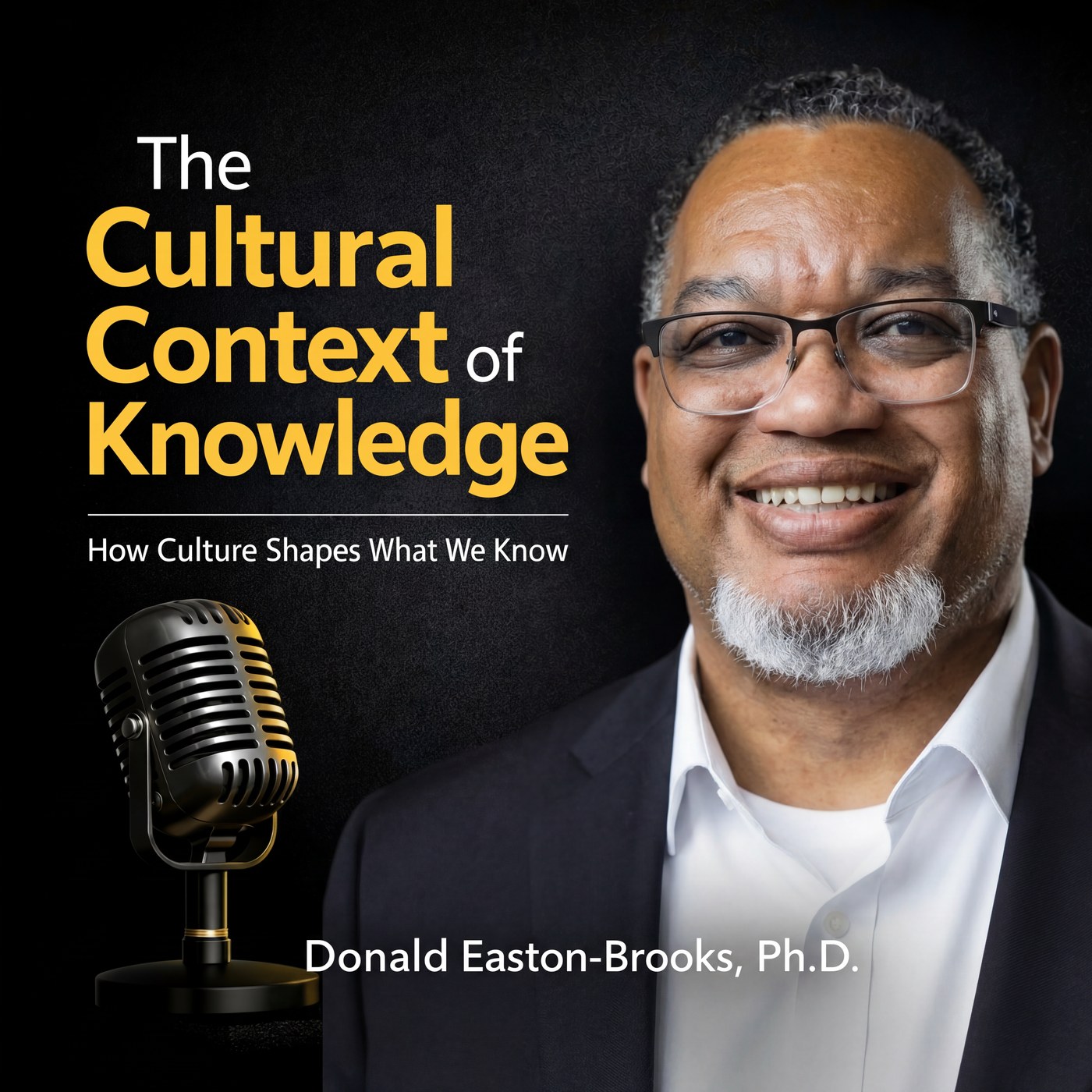
Episode 4 is the second featured episode of Season 1, and it is the one that takes the show’s central argument into the place most listeners assume the argument cannot reach, math, science, engineering, and computer science. The phrases are familiar. Math is objective. Science is factual. Engineering is technical. Data speaks for itself. Episode 4 makes the case, carefully, that none of those phrases are neutral. They are claims about culture wearing the costume of objectivity.
The episode is framed differently from the rest of the season. Don calls it a guided professional learning moment, something a STEM educator can absorb, pause, and revisit. The structure is closer to a coaching session than a lecture. The argument is plain. STEM classrooms often privilege linear reasoning, speed, abstraction, individual performance, and language-heavy explanations. Those are not universal ways of knowing. They are academic traditions that have been normalized as intelligence.
This is a featured episode for a reason. It takes the season’s hardest argument, that knowledge is culturally shaped, and applies it to the disciplines most institutions treat as the gold standard of cultural neutrality. If the argument holds here, the argument holds everywhere. And the episode is careful to say what the argument is not. This is not about lowering standards. This is not about adding bits of culture onto STEM like sprinkles. This is about redesigning STEM so rigor is not confused with restriction, and so students do not have to earn belonging before they can learn.
The student you already know
The episode opens by asking you to picture a specific student. A student who clearly understood a STEM idea but struggled to show it in the right way. Maybe they could explain it verbally but not in writing. Maybe they could build it but couldn’t formalize it. Maybe their reasoning was solid but they worked too slowly to be rewarded.
Hold that student in your mind, the episode says, because what happened in that moment was not an exception. It was a signal.
Where neutrality is hiding
In many classrooms, neutral practices show up in specific ways. One correct path to a solution. Timed assessments treated as indicators of intelligence. Word problems stripped of context. Silence interpreted as focus. Speed interpreted as mastery. None of those practices are actually neutral. They privilege students who already align with traditional academic norms while others are forced to translate their thinking before it can even be recognized.
Translation is labor. Over time, it becomes a tax. The episode names it directly. The misrecognition tax, the cost of doing extra cognitive work in a system that does not see your reasoning unless you reformat it into the dominant style. That tax is paid in attention, in confidence, and eventually in belonging. And the most important thing to notice about the tax is that it is being collected long before the student ever gets to the math.
The episode then reframes the question that drives most STEM equity conversations. Instead of asking why don’t students get STEM, try asking what kinds of sense-making does this STEM environment allow? That single shift moves the diagnostic from the learner to the structure, which is exactly where the cultural-context argument has been pointing all season.
Where learning begins: flip the order
The first redesign move in the episode is structural. Traditional STEM instruction often starts with abstraction, formulas, definitions, procedures, and only later connects to real applications. That sequence assumes abstraction is accessible to everyone. It isn’t. A culturally responsive approach flips the order.
Start with systems students already recognize. Why ride-share prices surge. Why bridges vibrate. How social-media algorithms shape visibility. Why materials fail. How energy moves through everyday devices. Let students notice, question, and reason first, in their own language. Then bring formal notation in as a tool, not as a gatekeeper.
This does not lower rigor. It strengthens conceptual grounding. Students do not just memorize formulas. They understand the problems those formulas were designed to solve. The formula appears in its proper place, as a translation of lived experience into a compact form, not as a barrier the learner has to clear before they are allowed to think.
E equals MC squared, taught culturally
The episode runs the most iconic formula in science as a worked example. E equals MC squared. For many students this formula feels untouchable, like something only brilliant people understand. The episode argues it is not magic. It is simply describing reality. Matter and energy are two expressions of the same thing. Even small amounts of mass hold enormous amounts of energy.
How do you teach that culturally? Not by starting with the equation. Start with everyday energy, fuel, food, electricity, heat, and ask where all this energy comes from. Students can talk about that. They can talk about power outages, gas prices, community energy needs. Now introduce mass, not as vocabulary, but as something real, the material in cars, buildings, phones, tools. Explain that matter is not static. It is concentrated energy.
Then the formula appears. E equals MC squared becomes a way to write down what students already know. Mass and energy are linked. The speed of light squared shows the scale of that relationship. From there, connect to phenomena students recognize, why nuclear energy is so powerful, how the sun produces energy, why energy policy matters.
The rigor is still there. Units, variables, calculations, derivations. The difference is that the abstraction grows out of meaning rather than being parachuted on top of it.
Reasoning, expressed many ways
The second redesign move is in how students are allowed to express reasoning. Neutral STEM classrooms often reward certainty, speed, and single-path solutions. Real STEM is messier, collaborative, iterative, often slow. The episode argues that classrooms can reflect what the discipline actually is. Invite students to explain thinking through diagrams and models. Let them work collaboratively. Treat errors as data. Show reasoning, not just answers.
The episode pauses here for the questions that matter most for an educator. Do you reward only correctness? Whose strategies get affirmed publicly? Do students get to think out loud, or only perform certainty?
This is also where the myth of neutrality does the most damage. Time-to-test, language-heavy assessments, and single-answer tasks measure speed and familiarity with academic norms, not necessarily understanding. A redesigned approach separates what students know from how they show it. If the goal is understanding, students might demonstrate it through models, oral explanations, lab design, real-world applications, or written reflections on iterations. Rigor does not disappear. It becomes more precise.
The episode is worth quoting closely on this point. Think of one assessment you currently use. What is it actually measuring? What alternative evidence could show the same understanding?
Whose expertise is technical?
A third redesign move concerns whose knowledge gets recognized as technical. Students arrive with rich experiential knowledge, mechanics, systems, materials, technology. Schools often don’t recognize it because it’s informal. Redesign honors that knowledge as real data.
The pause-and-reflect prompt here is one of the sharpest in the episode. Whose experiences are treated as technical knowledge in your classroom? What expertise goes unseen?
For an educator, the question lands hardest in the moments where it is true that the student in front of you knows something the curriculum does not yet recognize. A student who has worked on cars knows fluid dynamics in a usable way. A student who runs a small business has internalized inventory math. A student who has helped a family member manage a chronic condition has practical statistics. None of that experience is irrelevant to STEM. The redesign is the practice of building bridges between informal expertise and formal notation rather than treating informal expertise as something to be left at the door.
Collaboration, expressiveness, and the meaning of focus
The episode also takes on the cultural assumption that silence is a sign of learning. STEM classrooms often reward silence, individual work, and emotional restraint. In many cultures, collaboration and expressive engagement are signs of learning, not distractions. Redesign means recognizing productive noise, teaching collaboration explicitly, and questioning our own assumptions about what intelligence looks like.
Don’s prompt for the educator is direct. Why do I associate intelligence with speed? Why does silence feel like learning? How has my training shaped what I see as legitimate knowledge?
This is not about guilt. It is about growth. The training every educator received was itself culturally calibrated. Recognizing the calibration is the first move toward redesigning around it.
Why this is a featured episode
Three reasons.
First, STEM neutrality is the most rhetorically protected version of the broader knowledge-neutrality myth that the entire show pushes back against. If a listener can hold the argument here, they can hold it anywhere. The episode is the proof of concept for the show’s claim that knowledge frameworks are culturally calibrated, even, especially, when they appear most objective.
Second, the episode functions as a workshop. Most episodes give listeners a frame and a question. This one gives listeners a redesign protocol with concrete moves. Flip the start of learning from abstraction to systems. Decouple knowing from showing. Recognize informal expertise as technical knowledge. Question what silence and speed mean in your classroom. Each move is small enough to try this week and large enough to change the texture of a unit.
Third, this episode does the show’s most useful work for U.S. educators specifically. Many of the listeners closest to this content are STEM teachers, department chairs, and instructional coaches who have been told for their entire careers that culture is something that gets bolted onto their curriculum, if it gets bolted on at all. Episode 4 makes the opposite case. Culture is already in the curriculum, in the assessments, the expected pace, the form of expression that gets praised. The redesign move is not to add culture. The redesign move is to see the culture that is already there and decide whether it is doing what you want it to do.
A few questions worth sitting with
When you describe a good STEM student, whose image are you describing? Where did that image come from? Who benefits from it, and who becomes invisible because of it?
In your most recent unit, was the abstraction parachuted in or grown out of a system students could recognize? If a student arrived without the abstraction, what informal expertise would they have brought instead, and would your assessment have seen it?
Think of one assessment you currently use. What is it actually measuring? What alternative evidence could show the same understanding?
Where, in your own teaching life, have you mistaken speed for mastery? Silence for focus? Conformity for rigor?
Three things to try this week
Flip one lesson. Pick a single upcoming lesson and start it with a system students already recognize before any formula appears. Spend the first part of the lesson letting students reason in their own language. Bring the formal notation in only after they have shown you the structure they already see.
Audit one assessment. Pick one assessment you regularly use and answer two questions in writing. What is this measuring? What alternative evidence could show the same understanding? Write a short version of that alternative evidence, even if you don’t deploy it this week. The audit is the move that matters.
Notice one tax. For one class, watch for the misrecognition tax. Notice the moments a student is doing strong reasoning but losing credit because the form of expression doesn’t match the rubric. Don’t fix it on the spot. Just note it. After three or four sessions of noticing, you will have data, and that data is the start of a redesign that honors rigor without confusing rigor with form.
A closing note
The episode ends on a single sentence that is worth keeping close. Recognition opens the door. Redesign transforms the system. That is the entire arc of the show in nine words. Episode 4 is featured because it makes the recognition specific and the redesign concrete, and it does both inside the disciplines that have most insisted they were exempt from the conversation.
STEM is not just what we teach. It is how we understand the world. The redesign is not a softening. It is an upgrade. And it is one that more accurately reflects how knowledge is actually built, through human experience, collaboration, curiosity, and context.