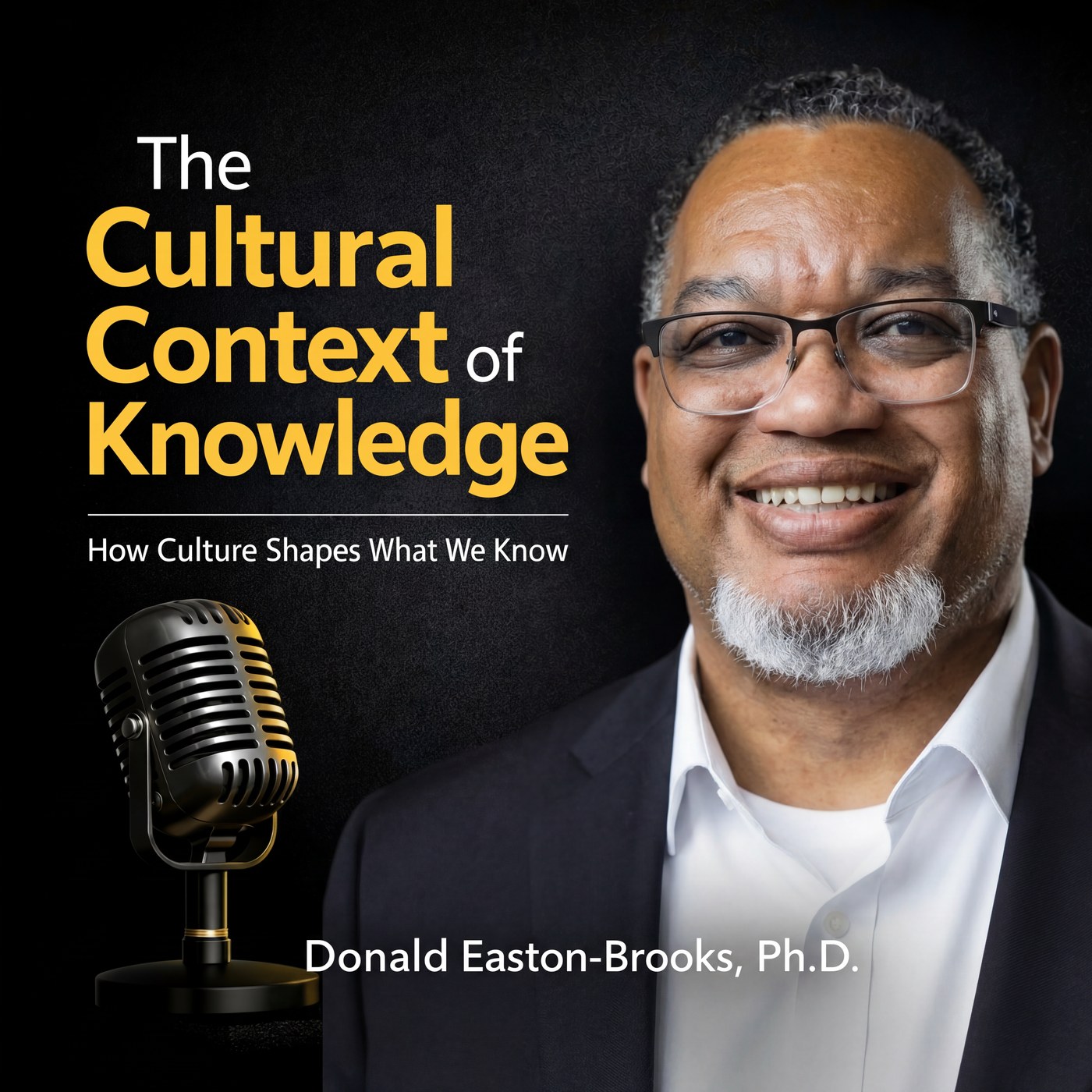
If Episodes 1 and 2 set up the show by examining how learning works, Episode 3 sets up the show by naming the question underneath everything. What counts as knowledge? Whose knowledge gets recognized inside a school? Whose is treated as background, decoration, or deficit? Most of education is built on the assumption that the answer is obvious. Curriculum, standards, and assessment are designed as if knowledge is universal and neutral. Episode 3 makes the case that it isn’t.
This is the foundational episode for the whole show, and the one that travels best across audiences. A teacher can listen to it. A learner can listen to it. A parent, a policymaker, a department chair, anyone who lives inside a U.S. school can listen to it and find something useful to do on Monday.
The argument in one paragraph
Knowledge does not float above culture. It is shaped by history, language, lived experience, and institutional power. Schools tend to operate inside what the episode calls grand or master narratives, a set of dominant beliefs about success, merit, and intelligence that get treated as universal. Because those beliefs are assumed to be neutral, they rarely get questioned. But neutrality is a form of power. When schools treat one form of knowledge as the standard, everything else becomes “different” or “less than.” The result is a system that systematically misrecognizes the strengths students bring from home.
The constructs that anchor this episode
The episode introduces several ideas that recur throughout the season. They are worth naming clearly so you can hear them again later.
Funds of knowledge. Every learner arrives in a classroom with skills, values, and ways of thinking shaped by lived experience. These are not background facts. They are intellectually rich. When schools fail to see them, it is not because they are absent. It is because the school is calibrated to recognize a different inventory.
Cultural discontinuity. When a lesson assumes everyone shares the same family structure, the same holidays, the same cultural references, the impact is the opposite of inclusive. Students whose lives don’t match the script get quietly positioned as outsiders. The teacher may have done nothing wrong. The system did the positioning.
Community cultural wealth. The strengths students bring, linguistic flexibility, social networks, navigational skill, aspirational vision, resilience, are real assets. They are also overlooked because they don’t show up cleanly on a test.
The misrecognition tax. This is the cost the system imposes on learners whose knowledge gets misread. The tax is paid in extra cognitive labor, the work of translating between home knowledge and school expectations, the work of code-switching, the work of deciding which parts of yourself are safe to bring into the classroom. Students learn quickly what kinds of knowing get rewarded. They are not wrong to learn it. They are responding to the conditions around them.
Why this matters before anything else in the season
If Episode 3 is right that knowledge is culturally shaped, then every later episode follows from it. STEM neutrality (Episode 4) becomes a knowledge-framework question, not a curriculum question. The seven-phase learner series (Episodes 5–11) becomes a tool kit for navigating a system that wasn’t necessarily built with every learner in mind. Season 2’s whole arc, who decides what counts, how knowledge becomes legitimate, who gets to teach it, what happens during a backlash, is downstream of the question this episode raises.
The episode does not argue for lowering the bar. It argues for noticing where the bar was set, by whom, and on whose terms.
A few questions worth sitting with
Think about the most recent lesson you taught or the most recent assignment you completed. Whose knowledge was treated as the default? Whose was treated as additive?
Where in your own school history did you pay a misrecognition tax? Where did someone you know pay one?
If you redesigned one assessment so it could see the strengths students bring from home, without lowering the standard, what would change about it?
One thing to try this week
Pick one routine in your classroom, your study group, or your team. Ask a single question about it: who benefits from this routine, and who is asked to translate themselves to participate? You don’t need to redesign the routine yet. The first move is just learning to see the calibration. Once you can see it, the redesign moves get a lot easier, and the rest of this season will keep handing you tools to make them.