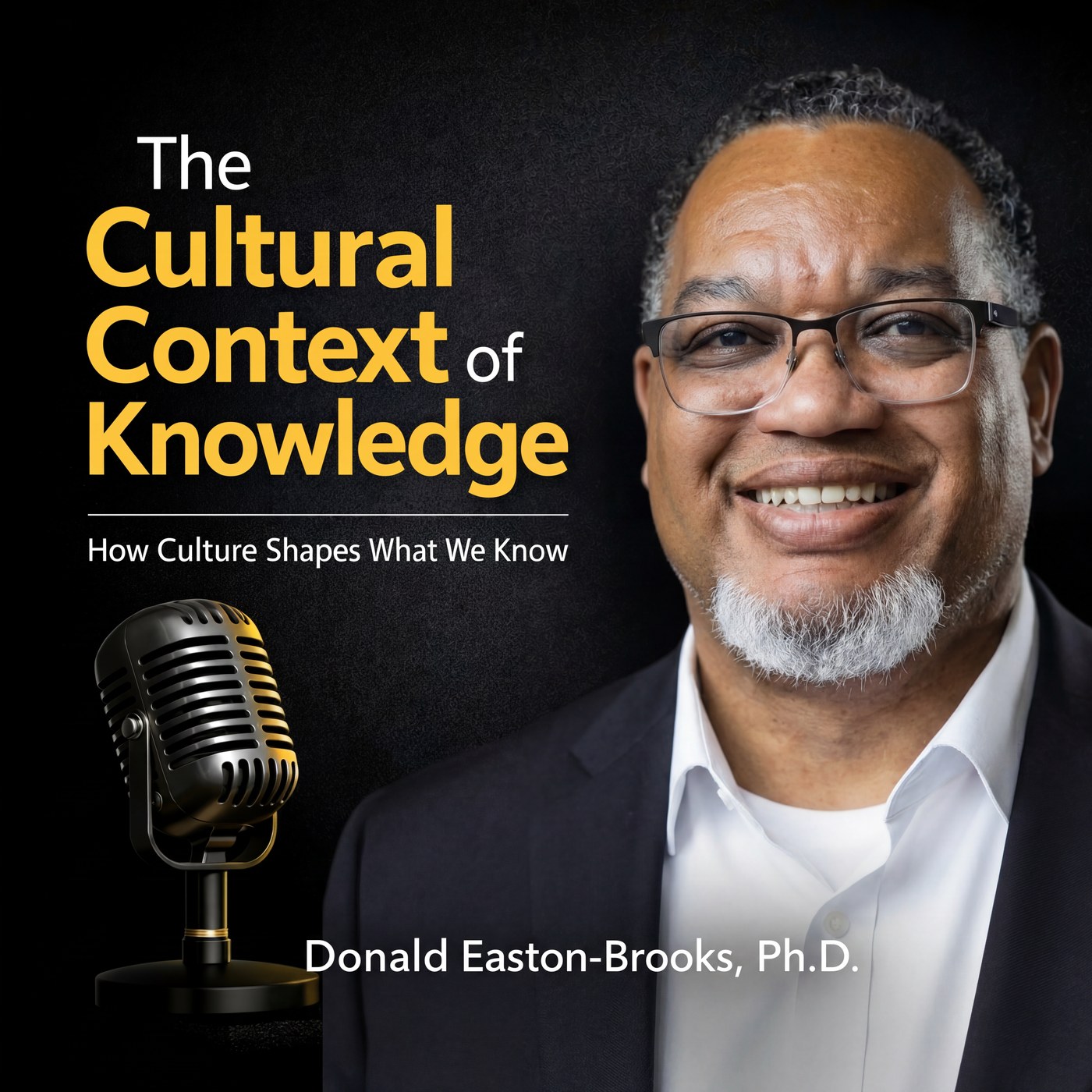
How State Standards Get Written: Curriculum as Compromise
Listen to The Cultural Context of Knowledge on one of your favorite podcast players.
- 00:00Cold open — the meeting
- 01:30What is being decided
- 02:30Where this episode sits in Season 2
- 03:45What state standards actually are
- 06:00Pause and reflect — did you ever hear the word 'standards'
- 06:45Curriculum as compromise
- 08:30Standards revisions in plain view
- 09:30Who is at the table, and who is paying for who is not
- 11:30Cultural context check — laundered into a fact
- 13:00What accountability could look like
- 15:00Moving the cost
- 15:30Do this this week
- 17:30Landing line
“A document written in a meeting you have never seen still walks into your child's classroom every morning.
Read the full transcript
I want to start with a meeting.
Imagine a state standards committee. The committee is in charge of writing the document that will decide what every public-school student in the state studies, in what order, and to what depth, for the next decade.
Picture the table. It is long. There are about twenty people seated around it. Picture who is at it.
Most of them are professional educators or administrators. Some are content specialists from universities. There is usually at least one representative from a major textbook publisher. There is sometimes a parent, often selected by political appointment. There is sometimes a representative from the state's business community. There is rarely, if ever, a current classroom teacher who is not also a department chair or a curriculum director.
There is even more rarely a learner.
Now picture who is not at the table. Picture the communities whose histories are about to be written into or out of the document. Picture the language speakers whose languages will or will not be recognized. Picture the parents whose understanding of what their children should learn will not enter the meeting in any direct way at all.
Hold that picture.
end chunk.
What is being decided around that table is not, technically, a curriculum. It is a standards document.
But what comes out of that meeting will shape what every public-school child in the state learns for the next ten years. It will shape what their textbooks contain. It will shape what their tests measure. It will shape what their teachers are trained to deliver.
It will shape, in other words, what counts as knowledge for a generation of children whose families were not in the meeting.
end chunk.
Episode 8. Curriculum as Compromise.
Across this season, we have traced a single relationship. Knowledge and power.
Two episodes ago, we named what schools have been doing to many children of color for decades, the developmental harm researchers have called curriculum violence. Last episode, we followed the same harm into the newest gatekeeper between learners and what they are trying to know, the AI model trained on a record that was never the whole record.
Today, we go further upstream. To the place where the curriculum the AI was trained on, and the curriculum the children are inheriting, actually gets written.
Not the textbook. Not the syllabus. The standards document underneath both.
Most public conversation about curriculum is about what is in the textbook. Today's episode is about something else. Today we ask who is at the table when the standards that govern every public-school classroom in a state are decided. And we ask what it costs the children whose families are not at that table.
end chunk.
Let me back up and explain what state standards are, because they often hide in plain sight.
A state standards document is the official statement of what students in that state are expected to learn at each grade level, in each subject. Math standards. Reading standards. Science standards. Social studies standards. Every public school in the state, and most charter schools, and many private schools, builds its curriculum from those standards. Textbook publishers build their textbooks to align with those standards. Standardized tests are designed to measure those standards. Teacher-preparation programs train new teachers to deliver those standards.
When you change the standards, you change everything downstream of them. When you don't change the standards, nothing downstream of them moves much either.
The standards documents themselves are, by now, deeply institutionalized. They get revised on multi-year cycles. The revision process is, in most states, governed by a committee, advised by content experts, opened for public comment, and finalized by the state board of education.
That sounds neutral. It is not neutral. The committee composition, the expert selection, the public-comment process, each of those steps is a place where the question of whose knowledge counts gets answered, mostly without anyone having to say so out loud.
end chunk.
Take a breath.
Think about your own K through 12 education. Did you ever hear the word standards before you became an adult? Did you know there was a document somewhere that decided what got into your textbook and what didn't?
Most of us didn't. The document was running the entire learning experience. We just weren't in the meeting when it was written.
Here is the frame I want to introduce.
A standards document is not the truth about a subject. It is a compromise about a subject. It is what a particular group of people, in a particular time, in a particular state, with a particular set of political and institutional pressures on them, agreed to call the subject. The compromise is then taught for the next decade as if it were the subject itself.
Sometimes the compromise is a strong one. The math standards in a given state may genuinely reflect the best thinking of working mathematicians and seasoned math educators about how children learn arithmetic and algebra.
Sometimes the compromise is a thin one. The history standards in a given state may reflect what the state's political leadership felt comfortable allowing into a textbook in a particular year, with a particular electorate watching.
Sometimes the compromise is a fight that one side won loudly... and the other side lost quietly.
end chunk.
In all cases, what reaches the classroom is not the subject. It is the most recent settled answer to a question about the subject, an answer that was negotiated by people with very specific interests, in a meeting most of us never see.
Look at any standards revision controversy in the last twenty years and you can see the negotiation in plain view. The Texas social studies standards revisions have been studied for years as a case where the political composition of the state board reshaped the historical record taught to millions of students. The science standards in several states have been the site of running fights over how evolution and climate are presented. The recent waves of state legislation we discussed in Episode 5 are, in part, attempts to legislate inputs into the next round of standards.
end chunk.
I want to be precise about the structural problem here.
Researchers who study standards-setting have documented something the public conversation often misses. The standards process is, by design, dominated by certain voices over others.
Disciplinary content experts, usually professors at large universities, are heavily represented. Classroom teachers, especially elementary teachers and teachers from rural or small-district schools, are far less represented in the actual writing. Communities of color, English-learner communities, Indigenous communities, and disability communities are typically represented through advocacy organizations, if at all, rather than through the parents and elders and learners whose lives are most directly shaped by what the document says.
The textbook publishing industry is represented in the meeting in a way most parents would find surprising. Three or four publishers dominate the U.S. textbook market. Their commercial interest is in producing materials that can be sold across many states. That gives them a strong, structural pressure to push the standards toward forms that align with their existing catalog.
end chunk.
Now think about who is paying for the absences.
When a community's history is left out of the standards, the cost is not paid by the people who left it out. It is paid by the children of that community, who will spend twelve years not seeing themselves in the official record.
When a tradition's way of knowing is filed as informal because it does not match the institutional template, the cost is not paid by the institution. It is paid by the learner whose grandmother taught her things the school will not let her cite.
This is the same pattern we named last episode in the context of AI. Power expressed through knowledge produces an asymmetric cost. The people on the receiving end of the decision pay the cost. The people making the decision often do not have to.
The standards document is where that cost-asymmetry gets institutionalized for a decade at a time.
end chunk.
I want to bring this back, one more time, to the relationship at the center of the season. Knowledge and power.
The standards document is the most concentrated expression we have, in U.S. public education, of the gap between who decides what counts as knowledge and who is required to live with that decision. The gap is structural. It is not a failure of any particular committee. It is built into the architecture of how standards get made.
Once the standards document is finalized, it begins to do the work the season has been describing. It tells textbook publishers what to print. It tells testing companies what to measure. It tells teacher-preparation programs what to teach the next generation of teachers. It tells future AI training datasets what knowledge looks like.
The compromise made in that meeting becomes the canon by which a generation of children is educated. Within a few years, the people in the meeting are not even named anymore. The compromise has been laundered into a fact.
That is what knowledge and power look like when they meet a state standards committee. The decision belongs to a small group of people, made in a single decade, with very specific interests at the table. The consequence belongs to children. For ten years.
end chunk.
We have named the structure. The harder question is what accountability could look like at the level of standards-setting.
The same framework that helped us name an accountable response for AI is useful here. Culturally responsive education, as built by Gloria Ladson-Billings, Geneva Gay, and Django Paris, insists that good education is not just delivered to non-dominant communities. It is built, in part, from the knowledge those communities already carry.
Their elders, their families, their traditions are not the audience. They are the source.
Apply that principle to standards-setting. An accountable standards process would not just include community advocates in the public-comment step at the end. It would include community elders, classroom teachers, and learners themselves in the actual writing, not as token consultations but as voting members of the committee. The training data of the next generation of curriculum would lead with the knowledge the table has historically had to be specifically prompted to remember.
Some states have begun small versions of this work. Some Indigenous nations have asserted curriculum sovereignty over what is taught about their histories in public schools on or near tribal land. Some districts have built community-curated curriculum supplements that sit alongside the state standards. These are early moves. They are not yet the standard. But they are the model for what an accountable standards process could look like.
end chunk.
And here is the deeper accountability move, the one that brings the season's argument to its sharpest point.
Right now, the cost of a thin compromise falls on the children whose families were not at the table. An accountable process would put the cost on the table itself.
It would require the people who write the standards to live with what they decide, by ensuring that the people who do live with what gets decided are the people writing it.
end chunk.
Take a moment.
Think of one subject you learned in school that you have since learned much more about as an adult. Think about the gap between what you were taught and what you now know.
Where did that gap come from? Some of it is normal, knowledge moves, you grew up. But some of it is the compromise. Some of it is what the meeting could agree to put in the document the year you were in school.
Now think about a child in your life. Think about what compromise is being decided right now, in a meeting they will never see, that will shape what they are taught for the next ten years.
For educators, here is a practice. Pull the actual standards document for the subject and grade level you teach. Read the introduction, not the standards themselves, but the foreword, and the acknowledgments, and the committee list. Read who wrote it. Read what year it was last revised. That five minutes will change how you read the rest of the document.
end chunk.
For parents and community members, here is yours. Find out when your state's next standards revision cycle is scheduled. Most states post these publicly. Find out how public comment works. Find out who is on the committee, and how members are selected.
The process is more open than people realize. The reason it produces such narrow committees is that most of us don't show up to it. Showing up to it is the most direct lever any of us has on what gets taught.
For learners listening, here is a smaller move. The next time a teacher tells you that a topic is or isn't part of "the standards," ask which standards. Ask when they were last updated. Ask who decided. The question itself shifts the conversation from "this is the rule" to "this is a rule that some people made."
end chunk.
The standards document is the quiet floor under everything else we have been talking about this season. It is where the demographic pivot does or does not get reflected. It is where the new and the marginalized and the long-excluded do or do not finally enter the official record. It is where the compromises of our generation will be laundered into the curriculum of the next one.
If we want a different curriculum, we have to spend more time in the meetings where curriculum is actually written. Most of us have never been told we could.
Next time, we follow the standards document one step further into the system that it produces. Because what gets measured in school is not always what was learned. And what gets measured shapes what gets taught next, and what gets taught next shapes what students believe they can do.
The closing instrument of the legitimacy machine is the assessment. We open that one in the next episode.
A document written in a meeting you have never seen... still walks into your child's classroom every morning.
Until next time.
This transcript comes from the production script. Wording may differ slightly from the episode as aired.
- 01Ravitch, D. (2004). The Language Police: How Pressure Groups Restrict What Students Learn · Vintage Books.
- 02Loewen, J. W. (2018). Lies My Teacher Told Me: Everything Your American History Textbook Got Wrong · The New Press.
- 03Moll, L. C., Amanti, C., Neff, D., & Gonzalez, N. (1992). Funds of Knowledge for Teaching: Using a Qualitative Approach to Connect Homes and Classrooms · Theory Into Practice · 31(2) · 132–141.
- 04Ladson-Billings, G. (1995). Toward a Theory of Culturally Relevant Pedagogy · American Educational Research Journal · 32(3) · 465–491.
- 05Berliner, D. C., & Biddle, B. J. (2004). The Manufactured Crisis: Myths, Fraud, and the Attack on America's Public Schools · Basic Books.
- 06National Council for the Social Studies (2010). Social Studies for the Next Generation: Purposes, Practices, and Implications of the College, Career, and Civic Life (C3) Framework · NCSS Bulletin · 113.
Companion essay — How State Standards Get Written: Curriculum as Compromise
Get the notes, the references, and the reading list.
Join the email list and get the written companion and full reference list for every episode, plus the series reading list to start.
Continue the season
All episodes →
Will Education Pivot With It?: Designing for the World That Already Exists
We opened this season with a question. The demographic pivot has already happened. Will education pivot with it? After nine episodes describ…
When Assessment Becomes Gatekeeping: An Instrument That Was Never Calibrated Against You
Two students take the same standardized reading test. Question fourteen is about a regatta, a sailing race. The first student has been to th…
AI as the New Gatekeeper: Whose Knowledge the Model Was Built to See
The newest gatekeeper between learners and what they are trying to know is a model that fills silence with fluent invention. This episode na…