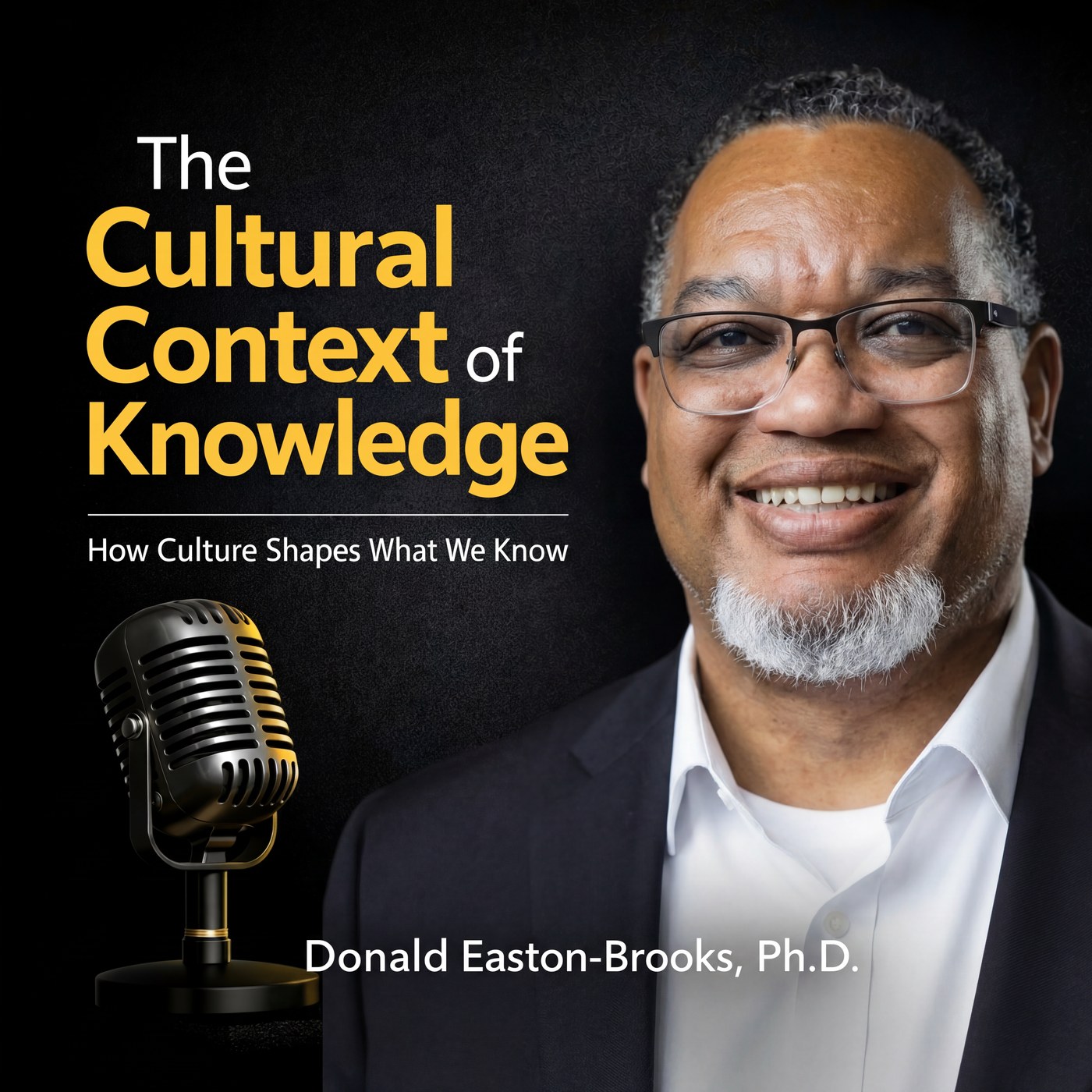
Memorization vs. Learning: How to Make Studying Actually Stick (Learner Edition, S1 E6)
Studying as memorization leaves information that disappears on tests or can't be used in real problems. Breaks down the difference between memorizing and learning so what you study actually sticks.
Listen to The Cultural Context of Knowledge on one of your favorite podcast players.
“Memorize the basics. Then turn them into learning through explanation, examples, and application.
Read the full transcript
Welcome to the Cultural Context of Knowledge podcast. I am your host, Donald Easton-Brooks. This podcast invites learners to pause and reflect on how their own cultural experience shaped the way they learn, interpret information, and define what counts as knowledge. Each episode, we'll focus on how cultural contexts impact the way in which we understand the world around us, whether it's the classroom, work environment, or relationships. In the last episode, we laid the groundwork for understanding learning and how your brain processes information. We use Bloom's six-phase technique to show how you can process learning.
Here we will put this concept into practice to help you, the learner, understand how to learn the concept presented in your classes. In this series, we will use a concept seen in nearly every sociology 101 course, social stratification. Let's start with the real scenario. You open your syllabus, see the midterm date, and look at the study guide. It feels like a wall of bold words. Social stratification, meritocracy, ascribed status, social mobility. You do what most people do. You try to brute force it. You reread the definitions over and over until the word stops sounding like meaning and start sounding like noise.
That's when study anxiety shows up. You start thinking, "This isn't working." You're right. It's not working. Not because you're incapable, but because rereading creates a trap. It makes you recognize the words without being able to retrieve the meaning. And recognition is not memory. So today, we're going to expand on phase one of Bloom's taxonomy, remembering, because you can't analyze, evaluate, or apply a concept you can't reliably pull out of your mind. Phase one is the foundation. Here's the key insight. Phase one is where learners get fooled by what feels productive. Highlighting feels productive. Rereading feels productive.
Even nodding along, saying, "Yeah, I've seen that before." Feels productive. But that's the illusion because you're not training your brain to produce the information. You're training it to recognize it while it's sitting in front of you. Phase one done correctly is uncomfortable on purpose. When you look away and your mind goes blank, that moment is not failure. It's the beginning of actual learning. So here is the method retrieval practice. You force your brain to pull the idea out without a safety net. That is the workout. Here's the phase one rule. Don't chase perfect definitions. Chase the core idea. In your notes, the definition of social stratification might be something like a society's ranking of people into a hierarchy.
Fine. But most learners get stuck memorizing the definition word for word. That's not phase one's goal. The goal is, can you recall the core idea when you need it? So, we do it like this. One, read the definition once. Two, put your notes aside. Three, say it out loud in your own words. Four, check your notes. Five, fix what you missed and repeat. You might say, "Social stratification is how society sorts people into layers, like a hierarchy." That's not the textbook sentence, but it is correct in meaning. Ranking, layers, and hierarchy. That's the win. And here's an extra move that matters. If you don't know what stratification or hierarchy means, look up those terms first.
Phase one still requires clarity in the language you're using. Now, let's talk about flash cards. If you use them the wrong way, you'll memorize vocabulary without a mental hook. So, here's the upgrade. Every flash card must include an example. Let's take social inequality. Your notes might say, "An unequal distribution of resources, power, or prestige." That's abstract. When something is abstract, your brain has trouble storing it. So, your flash card becomes on the front side the term social inequality. On the back side, the definition unequal distribution of resources, power, or prestige. Example, one person owns a private jet and another person can't pay rent.
Now, the definition includes a mental picture. That picture makes retrieval easier. That's phase one. Here's a simple routine you can run, especially for sociology 101 terms. Step one, pick key terms for social stratification. Your starter list might include social stratification, social inequality, social class, socioeconomic status, meritocracy, ascribed status, achieve status, and social mobility. Step two, create short retrieval questions, not essay prompts, short prompts that force recall, examples. Define social stratification in one sentence. Give a real life example of social inequality. What's the difference between ascribed status and achieve status?
In one sentence, what is meritocracy? Give one example of upward mobility. Step three, answer out loud without notes. Your brain may go blank at first. That's expected. That blankness is the signal you've found what needs practice. Step four, check your notes, then repeat. especially the misses. This is what separates I studied from I can recall. Let's do a fast demo so you can hear what this sounds like. Term one, meritocracy. Put your notes aside or look away and say it. Merritocracy is the belief that people get ahead because they earned it through ability and effort. Now add an example. A student believes grades always reflect hard work without considering access to tutoring, stable housing, or time to study.
That example matters because sociology is about seeing systems, not just individuals. Phase one doesn't require a long analysis, but it does require you to hold the meaning clearly enough that later you can analyze it. Term two, ascribe status. Put your notes aside or look away. Ascribed status is a social position you're born into or assigned like race, sex, or family background. Example, being born into a wealthy family versus being born into poverty. You're building the mental hooks now, so later when you hit exam questions, you aren't trying to learn for the first time under pressure. I want to emphasize this.
Speaking out loud is not a gimmick. It forces your brain to generate the idea in real time and it shows you instantly whether you can actually retrieve it. And remember, your goal is not perfect wording. Your goal is the core idea. Before you move on, you should be able to do three things for each term. One, define it simply. One sentence, your words. Two, give one example, real world, concrete. Three, answer a retrieval question without notes. If you can do that, you have earned phase one. And now you're ready for phase two. Because phase two is not just remembering words. Phase two is understanding meaning deeply enough to explain it, compare it, and connect it to what you already know.
So, as you wrap up today, here's your assignment. Simple and doable. from a class you may be in. Pick key terms from your course unit. Make 10 flash cards with examples. Write 20 retrieval questions and spend 10 minutes a day answering them out loud without notes. That discomfort you feel when your mind goes blank. That's not proof you can't learn. It's proof you found the exact spot where learning is about to happen. Next episode, we move to phase two, understanding. And we're going to take these same sociology terms and turn them into explanations you can actually own, not just repeat. Thanks for spending time with me on the Cultural Context of Knowledge podcast.
If you know someone who would benefit from this conversation, pass it along. It helps more people find the work. And subscribe wherever you listen. And I'll meet you back here next episode. I'm Donald Easton-Brooks. Until next time, take care.
This transcript was generated from the episode recording and may contain small transcription errors.
Companion essay — Phase One: Remember Without the Safety Net
Get the notes, the references, and the reading list.
Join the email list and get the written companion and full reference list for every episode, plus the series reading list to start.
Continue the season
All episodes →
From Studying to Transfer, Confidence, and Long-Term Growth (Learner Edition, S1 E11)
Closing the seven-part series: how to move beyond short-term studying and build learning that transfers across new classes, new problems, an…
Build Your Personal Learning System: A Repeatable Method That Works (Learner Edition, S1 E10)
A simple, repeatable learning system you can use for any subject — especially when motivation is low and pressure is high. Consolidates the…
When Learning Delays Happen, How to Catch Up Without Panic (Learner Edition, S1 E9)
What's really happening when you feel behind, stuck, or like nothing is clicking — especially under time pressure. Common sources of learnin…