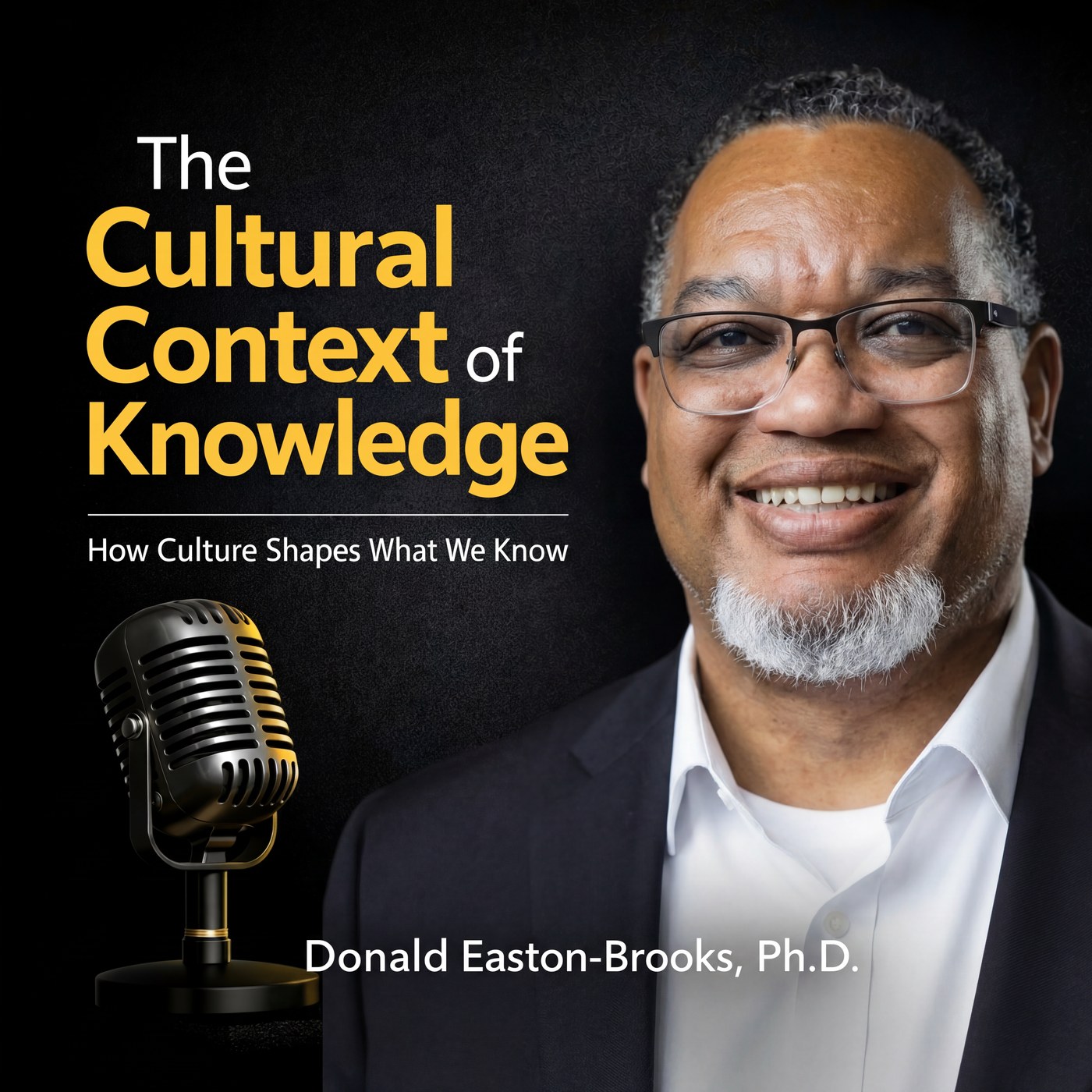
The Foundation — Whose Knowledge Counts? Culture, Power, and Learning
A foundational question most schools rarely name: what counts as knowledge, and who gets to decide? Moves beyond the myth that curriculum and assessment are neutral to examine how knowledge is shaped by culture and power.
Listen to The Cultural Context of Knowledge on one of your favorite podcast players.
- 00:00Welcome and the foundation of the show
- 00:30What counts as knowledge?
- 01:30Whose knowledge gets recognized
- 02:30Epistemology in the classroom
- 03:30Grand narratives and the myth of neutrality
- 04:30Funds of knowledge from the home
- 05:30Cultural discontinuity in everyday lessons
- 06:30Community cultural wealth and the misrecognition tax
- 07:30Redesigning learning through a cultural lens
“What counts as knowledge, and who gets to decide?
Selected passages from the recording.
- 00:30
Education is about knowledge — how we create it, how we share it, and how we decide what matters. But one of the biggest questions in education is also one we almost never pause to ask: what counts as knowledge?
- 01:30
Curriculum standards and assessments are designed as if knowledge is something neutral and universal. But it's not. Knowledge is shaped by culture, history, power, and context. When we forget that, we end up building schools that privilege some ways of knowing while pushing others to the side.
- 03:00
Most school systems operate inside what I call grand or master narratives — dominant cultures' beliefs about success, merit, and intelligence that get treated as universal truths. Because they're assumed to be neutral, they rarely get questioned. But neutrality is a form of power.
- 04:30
Every student brings knowledge from home — skills, values, ways of thinking that are rooted in their lived experience. These aren't just nice-to-have background facts. They're robust, meaningful, and intellectually rich. But too often, schools don't see that.
- 05:30
Imagine a teacher planning a lesson, assuming everyone celebrates the same holidays, has the same family structure, speaks the same way. The intention may be inclusive, but the impact can be the opposite. Students whose backgrounds don't align get subtly positioned as outsiders — not because of ability, but because the cultural script of the classroom doesn't match their lives.
- 06:30
Community cultural wealth names the strengths students bring — linguistic skills, resilience, social networks, navigational skills, aspirational goals. When that's overlooked, students end up paying what some scholars call a misrecognition tax: the extra emotional and cognitive work required to navigate an environment that doesn't fully see who they are.
- 07:30
If we really want schools to be equitable, we have to redesign learning through a cultural lens. That means rethinking how we define knowledge, how we assess it, and how we make decisions about teaching and learning. Curriculum needs to be relevant — not just comprehensive.
Read the full transcript
Welcome to the Cultural Context of Knowledge podcast. I am your host, Donald Easton-Brooks. This podcast invites learners to pause and reflect on how their own cultural experience shaped the way they learn, interpret information, and define what counts as knowledge. Each episode will focus on how cultural context.
Impact the way in which we understand the world around us, whether it's the classroom, work, environment, or relationships. In this episode, I present the foundation of this show, which centers on the relevance of the cultural context of knowledge for both educators and learners. This episode will serve as the basis for all other episodes.
Let's start this episode with a simple premise at its core. Education is about knowledge, how we create it, how we share it, and how we decide what matters. But here's the thing, one of the biggest questions in education is also, one, we almost never pause to ask what counts as knowledge. We often assume the answer is obvious.
Curriculum standards and assessments are designed as if knowledge is something neutral and universal, but it's not. Knowledge is shaped by culture, history, power, and context. And when we forget that, we end up building schools that privilege, some ways of knowing while pushing others to the side. So in this episode, I want us to slow down and really look at the cultural foundations of learning, not just what students learn, but whose knowledge gets recognized.
Whose is ignored and what happens when schools treat culture as an optional add-on instead of the center of learning? To get there, we need to talk about epistemology, basically how we know what we know. I know it sounds abstract, but in education, epistemology shows up everywhere. It's in whose stories make it into textbooks?
How we define intelligence, what we consider an evidence of learning. And who gets labeled as gifted behind or at risk? Most school systems operate inside what I call grand or master narratives, dominant cultures, beliefs about success, merit, and intelligence that get treated as universal truths. These narratives often come from western, middle class, monolingual, individualistic ways of thinking, because they're assumed to be neutral.
They rarely get questioned, but neutrality is a form of power. When schools treat certain forms of knowledge as a standard, everything else becomes different or less than cultural practices, community histories, bilingualism. Oral traditions and experiential knowledge are often treated as extras or worse as deficits, and that's not accidental.
It's tied to histories of colonization, assimilation, and institutional gatekeeping. Sociocultural learning theory helps explain why this matters. Learning is social. It's shaped by language, community, relationships, tools, values, all the things that make us who we are. So you can't separate learning from culture.
Students don't leave their identities at the classroom door. This is where the concept of funds of knowledge becomes so important. Every student brings knowledge from home skills, values, ways of thinking that are rooted in their lived experience. These aren't just nice to have background facts. They're robust, meaningful, and intellectually rich.
But too often schools don't see that. Think about it. If someone has four or five years of work experience, we value that. We assume it matters. But when a child walks into kindergarten with five years of cultural and cognitive development, we often reset them to zero. We ignore how they've made sense of the world up to that point, and when their home ways of thinking don't match school expectations, it creates a cultural mismatch, what we call cultural discontinuity.
So what happens when lessons are disconnected from students' lived realities? Imagine a teacher planning a lesson. Assuming everyone celebrates the same holidays, has the same family structure, speaks the same way, or shares the same cultural references. The intention may be inclusive, but the impact can be the opposite.
Students whose backgrounds don't align gets subtly positioned as outsiders, not because of ability, but because the cultural script of the classroom doesn't match their lives. This isn't a teacher problem, it's a systems problem. The concept of community cultural wealth adds another layer by naming the strengths.
Students bring things like linguistic skills, resilience, social networks, navigational skills, and aspirational goals. These are real assets, but they often get overlooked because they don't fit traditional measures of achievement. When that happens, students end up paying what some scholars call a misrecognition tax.
The extra emotional and cognitive work required to navigate an environment that doesn't fully see or value who they are. Students learn quickly what kinds of knowledge get rewarded. They learn when to speak, when to hold back, when to code switch, and when to hide parts of themselves. And that's not about ability or motivation.
It's a response to the conditions around them. The consequences are deep. Students disengage, identity conflicts. Surface learning becomes more about compliance than curiosity and too often. Schools interpret these outcomes as individual deficiencies instead of signs of systemic misalignment. So what do we do?
If we really want schools to be equitable? We have to redesign learning through a cultural lens. That means rethinking how we define knowledge, how we assess it, and how we make decisions about teaching and learning. Curriculum needs to be relevant. Not just comprehensive. Thanks for spending time with me on the Cultural Context of Knowledge podcast.
If you know someone who would benefit from this conversation, pass it along. It helps more people find the work and subscribe wherever you listen, and I'll meet you back here. Next episode. I'm Donald Easton-Brooks. Until next time.
This transcript was generated from the episode recording and may contain small transcription errors.
Companion essay — What Counts as Knowledge?
Get the notes, the references, and the reading list.
Join the email list and get the written companion and full reference list for every episode, plus the series reading list to start.
Continue the season
All episodes →
From Studying to Transfer, Confidence, and Long-Term Growth (Learner Edition, S1 E11)
Closing the seven-part series: how to move beyond short-term studying and build learning that transfers across new classes, new problems, an…
Build Your Personal Learning System: A Repeatable Method That Works (Learner Edition, S1 E10)
A simple, repeatable learning system you can use for any subject — especially when motivation is low and pressure is high. Consolidates the…
When Learning Delays Happen, How to Catch Up Without Panic (Learner Edition, S1 E9)
What's really happening when you feel behind, stuck, or like nothing is clicking — especially under time pressure. Common sources of learnin…