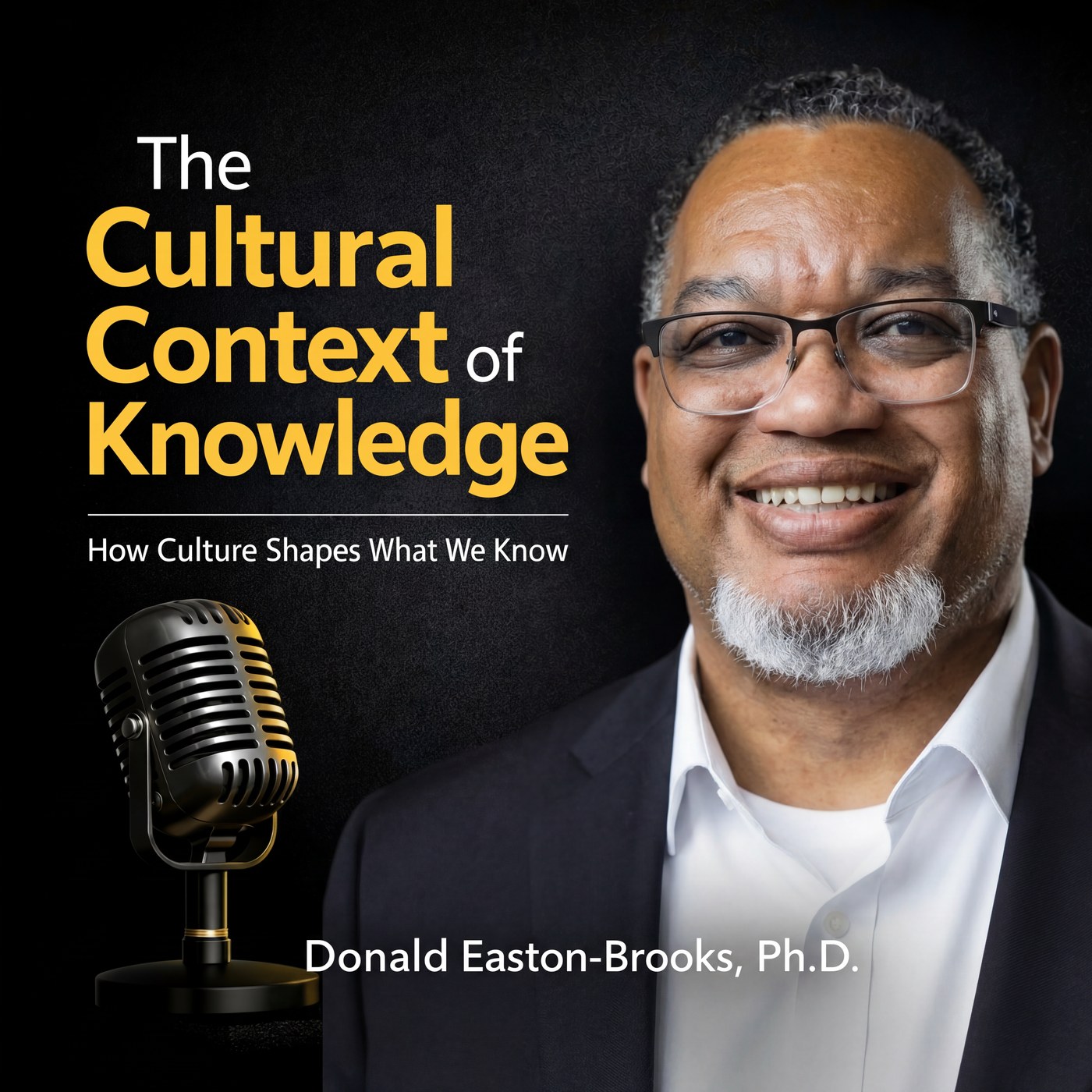
Knowledge, Power, and the U.S. Demographic Pivot
The classroom has changed — has education? For the first time in U.S. history, children under 18 are the majority non-white. Season 2 opens with the question: who decides what counts as knowledge?
Listen to The Cultural Context of Knowledge on one of your favorite podcast players.
- 00:00Welcome and Season 2's central premise
- 00:51From culture as filter to power as architect
- 01:36A 20th-century structure meeting a 21st-century classroom
- 02:13The numbers — who is in the classroom now
- 02:43Higher ed: 1955 versus today
- 03:48When the structure changed, outcomes changed
- 04:08Knowledge is curated, not neutral
- 05:30Alignment gap, not intelligence gap
- 06:14What institutions can do about it
- 07:02The pivot has already happened
“The classroom has changed. The question is whether education has.
Selected passages from the recording.
- 00:51
In Season 1, we explored how culture filters learning, how identity and lived experience shape understanding. In Season 2, we go deeper. This season centers on the power of knowledge — not just what knowledge is, but how it becomes legitimate, who authorizes it, who benefits from it, and what happens when the people in the classroom change but the knowledge system does not.
- 01:51
We are operating a 20th-century school structure with a 21st-century demographic. And that friction is not just producing uneven grades. It is producing an identity crisis for education itself.
- 03:06
Prior to the 1970s, the pattern was reversed. Higher education was overwhelmingly male. If a woman struggled in 1955, the assumption was not that the system was misaligned. The assumption was that she did not belong. Then the 1970s happened — civil rights legislation, the women's movement, Title IX, expanded financial aid. The structure shifted. Power realigned.
- 03:48
When the population changes, educational systems either evolve or they reinforce inequity. Now we are at another pivot.
- 04:25
Power does not simply suppress knowledge. Power organizes knowledge. It defines the structure of the knowledge framework itself — what counts as valid knowledge, who is recognized as a legitimate knower, how rigor is defined, how intelligence is measured.
- 05:30
Students whose backgrounds align with dominant norms are labeled naturally gifted. Students whose knowledge is rooted in community experience may be labeled underprepared. That is not an intelligence gap. It is an alignment gap.
- 06:07
Equity does not mean lowering the bar. It means ensuring the bar is not invisibly calibrated for one historical group.
- 07:09
The demographic pivot has already happened. The only question left is whether education pivots with it.
Read the full transcript
Welcome to the Cultural Context of Knowledge podcast. I am your host Donald Easton-Brooks. This podcast invites learners to pause and reflect on how their own cultural experience shaped the way they learn, interpret information, and define what counts as knowledge. Each episode will focus on how cultural contexts impact the way in which we understand the world around us. Whether it's the classroom, work environment, or relationships. If you've been listening to this podcast for a while, you already know the central premise. Knowledge is not neutral. What we learn, how we learn it, and whose knowledge is validated are shaped by culture, history, and power.
In season 1, we explored how culture filters learning, how identity and lived experience shape understanding. But in season two, we go deeper. This season centers on the power of knowledge. Not just what knowledge is, but how it becomes legitimate, who authorizes it, who benefits from it, and what happens when the people in the classroom change, but the knowledge system does not. Because right now, we are living through a structural pivot in US education. And that pivot forces us to confront a quiet question, one that almost no one writes on the whiteboard. who decides what counts as knowledge. There is a structural tension sitting in almost every classroom in the United States right now.
It's in kindergarten carpet circles. It's in AP physics labs. It's in university lecture halls. We are operating a 20th century school structure with a 21st century demographic. And that friction is not just producing uneven grades. It is producing an identity crisis for education itself. According to US census data, children under 18 are now majority non-white. Non-Hispanic white children make up roughly 47 to 48% of that population. In public K to2 schools, white students represent about 44% of enrollment. That means students of color collectively make up the majority of US classrooms. The classroom has changed and higher education is changing, too.
Today, women earn roughly 59% of all bachelor's degrees in the United States. Among adults ages 25 to 34, about 47% of women hold a bachelor's degree, compared to about 37% of men. But prior to the 1970s, that pattern was reversed. Higher education was overwhelmingly male. If a woman struggled in 1955, the assumption was not that the system was misaligned. The assumption was that she did not belong. Then the 1970s happened. civil rights legislation, the women's movement, Title 9 in 1972, expanded financial aid, the structure shifted, access expanded, power realigned. And when the structure changed, the outcomes changed.
Women did not suddenly become more capable. The system evolved. History teaches us something. When the population changes, educational systems either evolve or they reinforce inequity. Now we are at another pivot. We often talk about knowledge as if it exists outside culture, neutral, objective, universal. But knowledge inside schools is curated. It is selected, sequenced, framed, evaluated. Curriculum committees determine what is foundational within the knowledge framework. State boards define proficiency. Universities define what research is rigorous. Accreditation bodies define quality. These are exercises of power.
Power does not simply suppress knowledge. Power organizes knowledge. It defines the structure of the knowledge framework itself. The knowledge framework determines what counts as valid knowledge, who is recognized as a legitimate knower, how rigor is defined, how intelligence is measured, which forms of expression are rewarded. Knowledge does not float above culture. It is produced inside institutions shaped by history. And history reflects power. When men dominated universities, the knowledge framework reflected male experience. When women gained access, the framework expanded, research broadened, disciplines evolved, demographic change reshaped intellectual production.
Now we are witnessing another shift. The question is not whether math is still math. The question is how math is framed, what examples are used, what contexts are assumed, what forms of expression are validated. Because the hidden curriculum still operates, students learn not just content, but how to perform knowledge. Students whose backgrounds align with dominant norms are labeled naturally gifted. Students whose knowledge is rooted in community experience may be labeled underprepared. That is not an intelligence gap. It is an alignment gap. If we ignore demographic change, we risk mistaking misalignment for incapacity.
We risk confusing conformity with competence. We risk protecting tradition under the name of rigor. Equity does not mean lowering the bar. It means ensuring the bar is not invisibly calibrated for one historical group. So what should institutions do? Make standards transparent. Teach students how the knowledge framework operates. Expand the framework without abandoning rigor. Redefine rigor as intellectual depth, not rigid form. Align leadership decisions with demographic reality. This is not about political correctness. It is about institutional legitimacy. When educational systems fail to evolve with the populations they serve, they lose trust.
When they evolve intentionally, knowledge deepens. So as we enter season two, we are asking how knowledge becomes powerful, how knowledge frameworks are constructed, who authorizes them, who benefits from them, and how demographic change reshapes them. The demographic pivot has already happened. The only question left is whether education pivots with it. Season 2 is about that pivot, knowledge, power, and the cultural context that shapes what we decide is worth teaching. Until next time, keep questioning, not to dismantle knowledge, but to understand how it became legitimate and how it must evolve. Thanks for spending time with me on the Cultural Context of Knowledge podcast.
If you know someone who would benefit from this conversation, pass it along. It helps more people find the work. And subscribe wherever you listen. And I'll meet you back here next episode. I'm Donald Easton-Brooks. Until next time, take care.
This transcript was generated from the episode recording and may contain small transcription errors.
Companion essay — The Demographic Pivot
Get the notes, the references, and the reading list.
Join the email list and get the written companion and full reference list for every episode, plus the series reading list to start.
Continue the season
All episodes →
Will Education Pivot With It?: Designing for the World That Already Exists
We opened this season with a question. The demographic pivot has already happened. Will education pivot with it? After nine episodes describ…
When Assessment Becomes Gatekeeping: An Instrument That Was Never Calibrated Against You
Two students take the same standardized reading test. Question fourteen is about a regatta, a sailing race. The first student has been to th…
How State Standards Get Written: Curriculum as Compromise
State standards are the most concentrated place in U.S. public education where decisions about other people's children get made by people wh…